Every school year starts the same way.
Teachers get the syllabus. They plan. They map out which chapters need to be covered by which month. Everything looks manageable on paper.
Then the year actually begins.
A few chapters take longer than expected. A concept needs to be explained twice, then a third time. A school event cuts into two teaching days. And slowly, quietly, the plan starts slipping. By the third term, teachers are rushing. Students are half-prepared. And the chapters that needed the most time got the least.
This is not a new problem. It has been happening in Indian classrooms for decades.
But here is what is different now. There is a direct, practical solution to it. Not a workaround. Not a theory. A digital syllabus that puts curriculum-aligned content behind every chapter, every subject, for every standard.
That is what this guide covers.
What Is a Digital Syllabus, Actually?
Not a PDF of the curriculum document. Not a folder of downloaded videos. Not a WhatsApp group where someone occasionally shares a link.
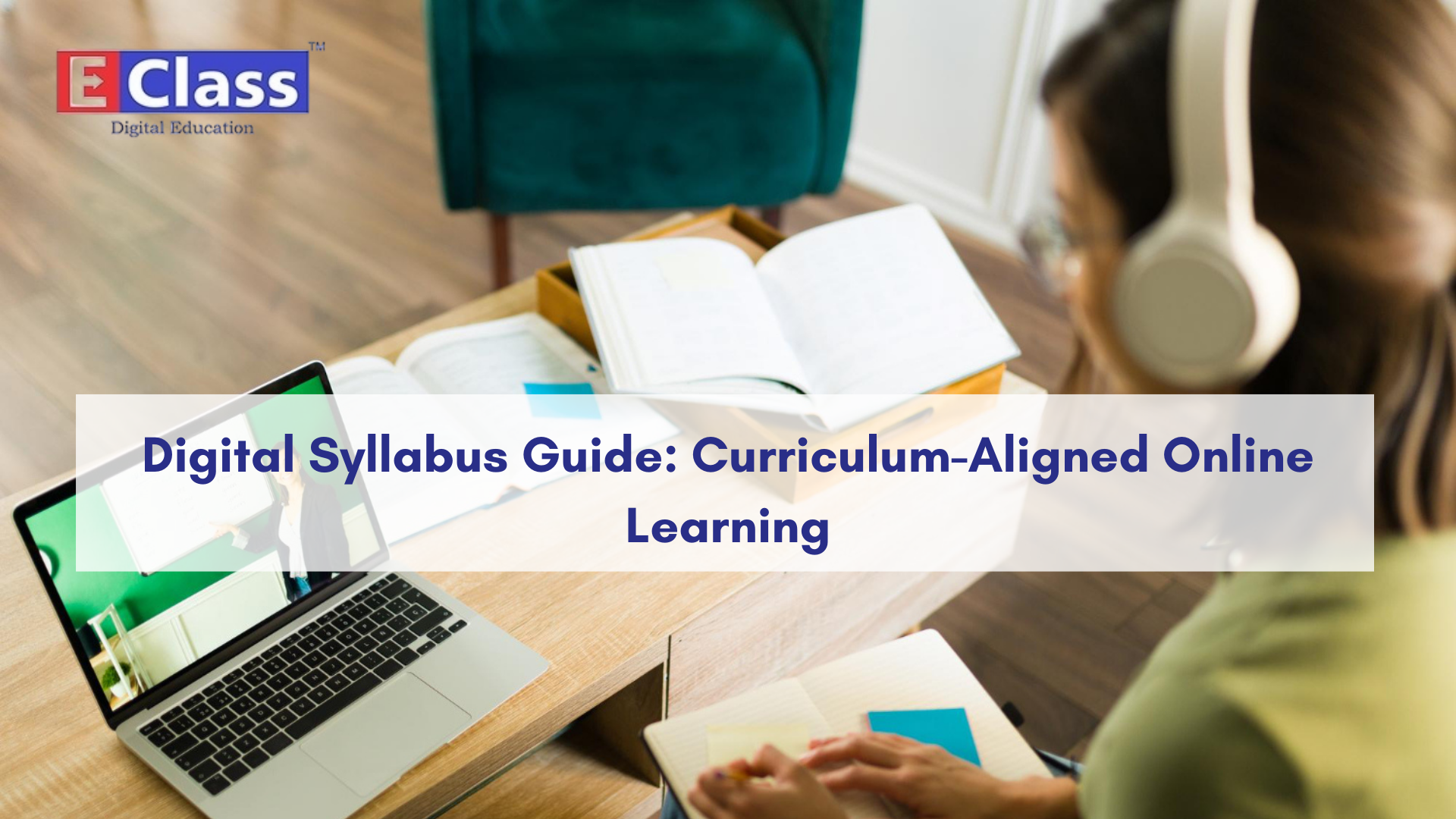
A digital syllabus is the complete school curriculum rebuilt in digital form. Structured. Organised. Mapped chapter by chapter to the exact Board and standard the school follows.
It means every chapter has an animated video lesson. Every subject has revision tools. Every student has a way to go back and revisit what they did not fully understand the first time.
And the one thing it absolutely must do, offline. Because a resource that needs internet to function will fail at the worst possible moment and eventually stop being trusted.
Think of it this way. The entire academic year, every subject, every chapter, ready to use in any classroom, any time. That is a digital syllabus.
Why Schools Actually Need This
Honest question. How much of last year’s syllabus was completed on time?
Not planned for completion. Actually completed, with enough time left for proper revision before exams?
Most schools, if they sit with that question honestly, will admit the answer is not great. And almost always, the reason is not that teachers are not working hard. They are. The reason is that teachers are working with tools that have not changed in generations.
A textbook and a blackboard are the foundation. They always will be. But they cannot, on their own, cover a full syllabus effectively, hold the attention of 40 students learning at different speeds, and still leave room for meaningful revision.
Something is always sacrificed. Usually the student who needed more time.
A digital syllabus fills that gap. It gives teachers ready content for every chapter so preparation time shrinks and teaching time grows. It gives students a way to revisit difficult concepts at home without waiting for the next class. And it gives schools a structure where syllabus completion stops being a race against the calendar.
What Curriculum-Aligned Actually Means
This phrase is everywhere. It deserves a precise definition.
Curriculum-aligned does not mean broadly educational. It does not mean loosely related to the topic. It means the content follows the exact textbook the student uses in school. Same chapter sequence. Same terminology prescribed by the Board. Same learning objectives the student will be examined on.
That precision matters enormously in practice.
A student watching a Science video that uses different terminology from their Maharashtra State Board textbook does not get clarity. They get confusion. A teacher using content that covers concepts outside their syllabus wastes time and misleads students about what they actually need to know.
Genuinely curriculum-aligned content removes both problems. What the student sees in the digital content is a direct extension of what is in their textbook. Same structure. Same language. Just animated, visual, and considerably easier to absorb.
What a Proper Digital Syllabus Includes
Not all digital syllabuses are built equally. Here is what a complete, well-built one should have.
Chapter Explanation Videos
The core of everything.
Animated videos covering each chapter in full, following the textbook structure. 2D and 3D animations for Science and Geography. Timeline-based storytelling for History. Step-by-step worked examples for Mathematics. Every subject has a visual dimension that a blackboard cannot fully capture. These videos do.
Mind Map Videos
Short. Structured. Built for one purpose: revision.
A mind map video covers the essential points of an entire chapter in a few minutes. Not a replacement for the full explanation. A reinforcement of it. Especially useful the night before a test when re-reading ten pages is not realistic.
Question and Answer Videos
Here is something schools often overlook.
Many students understand a concept when they see it explained but cannot express that understanding in an exam. They know the answer. They cannot write it. Q and A videos close that gap by showing students how to construct answers correctly, not just what the answer is.
MCQ Practice Sets
Multiple choice questions, chapter by chapter, subject by subject.
The value is immediate feedback. A student who gets a question wrong finds out now, not when homework is returned three days later. They can go back to the relevant segment of the chapter video and address the gap before it becomes a fixed misunderstanding.
PDF Notes and Chapter Summaries
Concise. To the point. Useful before a class test, useful for teachers who want a quick overview before starting a chapter, useful for students who prefer reading alongside video.
Multilingual Support
For Maharashtra schools, this is not optional. Content available in Marathi, Hindi, and English mediums is a basic requirement. A digital syllabus that does not match the school’s medium of instruction is a digital syllabus that will not be used. Simple as that.
How It Actually Works in a Classroom
Picture this.
A teacher is about to begin a new chapter. Instead of opening with the textbook, they play the chapter’s animated video. Three to five minutes. Students get a complete visual overview of the topic. Key terms introduced. Concepts shown, not just described.
Then the teacher takes over.
They expand on what students just watched. They ask questions. They correct misconceptions. They connect the new chapter to things students already know. The conversation that follows a shared visual experience is richer, faster, and more focused than one that starts cold from a textbook page.
After class, students can revisit the same video at home. Test themselves with MCQs. Use the mind map before the next lesson to consolidate what they covered.
The chapter does not end when the bell rings. It follows the student home.
What It Does for Students Who Are Struggling
This is where a digital syllabus changes things in ways that matter most.
In a classroom of 40, a teacher cannot slow down every time one student needs more time with a concept. That is not a failing. It is the reality of how classrooms work. The lesson has to move forward.
At home, that constraint disappears.
A student who found light refraction confusing can watch that chapter’s video again. And again. They can pause it mid-explanation. Rewind a specific part. Work through the MCQs and pinpoint exactly where their understanding breaks down.
That kind of patient, repeatable, curriculum-aligned access is something no tuition class can replicate at scale. And it is available to every student with access to the kit, not only the ones whose families can afford extra support.
Mistakes Schools Make When Going Digital
Worth being direct about these because they come up constantly.
Using content that is not aligned to their Board
General Science videos and History documentaries are not a digital syllabus. They are useful in their own context. They are not a substitute for content mapped to the specific curriculum a school’s students will be examined on.
Treating it as a one-time setup
Syllabuses change. Content needs to reflect that. Before choosing any provider, find out exactly how and how often updates are handled.
Reserving it for difficult chapters only
Some schools use a digital syllabus as a backup for topics that are hard to explain. This misses most of the value. It works best as part of the daily teaching rhythm, every chapter, every subject, consistently.
Ignoring the revision tools
Chapter videos are the most visible part. But the mind maps, MCQ sets, and Q and A content are where a significant portion of learning value lives. Schools that use only the videos are leaving most of the tool untouched.
What to Ask Before Choosing a Provider
A few questions that matter more than most sales conversations will surface:
Is it aligned to your exact Board, standard, subject, and medium? Get confirmation on each one specifically. Not a general yes.
Does it work offline? Turn the internet off during the demo. Not hypothetically. Actually.
How are syllabus changes handled? Ask for specifics. Who updates the content? How quickly? What is the process?
Is every chapter covered, or are there gaps? A digital syllabus with missing chapters is an incomplete tool.
Can a teacher navigate it without help every time? If it takes more than a brief orientation, it will not be used consistently. And inconsistent use means inconsistent results.
How do students access it at home? App, kit, SD card? On which devices? The more accessible it is outside school, the more value it delivers.
To Put It Simply
A digital syllabus is not a trend schools are chasing to look current.
It is a practical answer to a real problem. The gap between what a full syllabus demands and what teachers can realistically deliver with a textbook, a board, and 40 students looking back at them.
When every chapter has curriculum-aligned content behind it, teachers are better equipped. When students can revisit that content at home, understanding deepens. When schools build it into the daily teaching rhythm and not just the exam season, the results show.
Not as a promise. As something that has been happening in classrooms across Maharashtra for over a decade.
E-Class has built a complete digital syllabus for Maharashtra State Board schools from Class 1 to Class 10. Every subject. Every chapter. Fully offline. Available in Marathi, Hindi, and English mediums. Used across 2,000 schools and trusted by 10 lakh students.
Frequently Asked Questions
1. What is a digital syllabus and how is it different from regular digital content? A digital syllabus is the complete school curriculum rebuilt in structured digital form, covering every chapter of every subject in the exact order and language of the prescribed textbook. Regular digital content is general and unaligned to any specific Board or standard. In a classroom context, that difference is the whole thing.
2. Does a digital syllabus replace the teacher? No. It supports the teacher by providing curriculum-aligned content for every chapter. The teacher is still the one explaining, questioning, and responding to the specific students in the room. The digital content handles the visual and revision layer that a textbook and blackboard alone cannot fully provide.
3. Can students use it at home? Yes, and this is one of its most important uses. Students can revisit chapter videos, use mind maps for revision, and work through MCQ sets entirely on their own. For students who need more time with a difficult concept, this kind of access at home makes a real difference.
4. Does it need internet to work? A properly built digital syllabus works completely offline. Content is pre-loaded and accessible without a connection. For Indian schools and homes where internet reliability is unpredictable, this is not a feature. It is a requirement.
5. How is curriculum-aligned content different from what is available on YouTube? YouTube content is general, unstructured, and not mapped to any specific Board or textbook. Curriculum-aligned content follows the exact chapter sequence, uses Board-prescribed terminology, and covers what a student will actually be assessed on. One directly supports the syllabus. The other might, or might not, depending on what someone has uploaded.
6. What subjects and standards does a digital syllabus cover? A complete digital syllabus covers all core subjects from Class 1 to Class 10. Science, Mathematics, History, Geography, Civics, and languages, in the medium of instruction the school follows. Every chapter, not a selection of them.
7. How often is the content updated when the syllabus changes? This varies by provider and is one of the first questions worth asking. A reliable provider has a clear, timely process for updating content whenever the Board revises the syllabus and should be able to tell you exactly how that works before you commit to anything.